Navigating differences in faith while supporting loved ones through health challenges
Open communication, not persuasion, is key when belief systems differ among aging adults and their families
(Aging Untold) — For many older adults, faith plays a central role in daily life — but not for everyone.
The Aging Untold hosts explored how caregivers, families and individuals can navigate differing spiritual and religious perspectives, particularly as people age and deal with health challenges or approach the end of life.
According to AARP, about 80% of adults between 50 and 80 say their spiritual beliefs are important to them. At the same time, approximately 29% of Americans report no religious affiliation and are less likely to seek support from faith-based communities.
Respecting individual belief systems
Gerontologist and Aging Untold co-host Sam Cradduck said the key is honoring each person’s right to their own beliefs without imposing others’ views.
“You have to honor individual belief systems, and you have to honor their right to make their own choices and not impress your own,” Cradduck said.
Aging expert and Aging Untold co-host Amy O’Rourke said she has mixed feelings.
“If you’re really, really faithful and you really want everybody else to share your faith, you’re going to be the one that’s going to have to be extra, extra careful when you approach somebody that has a different view than yours, because it creates stress and anxiety, and it doesn’t allow room for the other person to really be where they are,” O’Rourke said.
She said people should hold onto their faith while being cautious about pushing it on others before understanding where that person stands.
Opening the conversation
Asking permission before starting a spiritual conversation can make a difference.
“Even opening up the conversation — would you like to have this conversation? Maybe they’ll say no. Maybe they’ll say yes,” O’Rourke said.
Or maybe they’ll ask about it later, aging-well coach and Aging Untold co-host Katherine Ambrose said.
Cradduck noted that religion and politics were historically considered taboo topics, but the issue is not that those conversations shouldn’t happen — it’s that people haven’t learned how to have them in a healthy way.
Asking someone what their thoughts are sets up the opportunity for conversation, Dr. Rhea Rogers, a board-certified physician and Aging Untold co-host, said.
“It’s open communication,” Rogers said.
Cradduck said a conversation about why the other person believes what they believe and how it brings them comfort also presents the opportunity to learn something new.
Faith differences at end of life
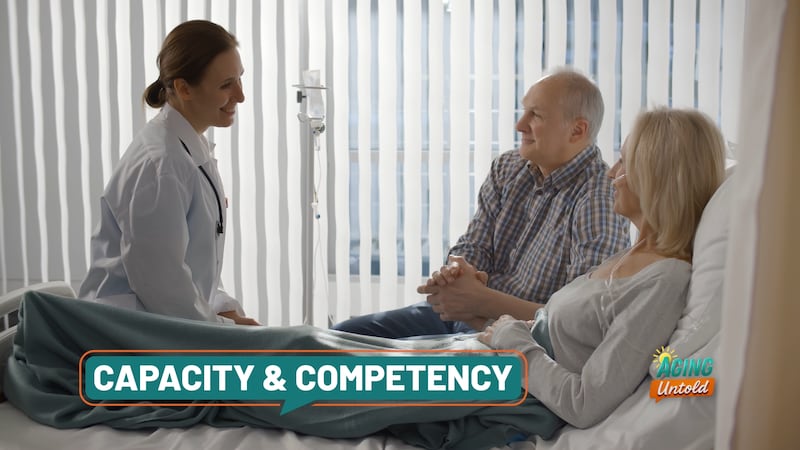
Cradduck said differing belief systems can become especially difficult when a loved one is nearing death.
“It’s really hard for family members sometimes to reconcile in themselves if their loved one is passing and they have a different belief system,” Cradduck said, describing a scenario in which an agnostic person is dying while a family member with strong religious beliefs tries to impose that faith.
“In doing so, you alienate that relationship,” Cradduck said.
Cradduck said family members who struggle with a loved one’s differing beliefs should seek guidance from their own spiritual counsel — a pastor, minister, or similar figure — rather than directing that pressure at the dying person.
“Don’t make them feel judged,” Rogers said. “You should not make them feel bad about what they believe. You need to be able to sit and listen and help them through their healing process, whatever that is.”
Ambrose raised the point of finding a way to hope and cope.
“Now, when it comes to taking action, what I see with a lot of people is the lack of confidence and that ‘faith it ‘til you make it’ is kind of play on ‘fake it to make it,’ like you just step into action, maybe not even quite knowing if you’re up to the task, but if you just take action and just trust that you’ll be equipped along the way, and by moving into action, it can, you know the truth will be revealed,” Ambrose said.
The value of listening
The hosts agreed that sometimes the most supportive role a person can play is simply listening and helping them through the healing process.
“Sometimes people just need to talk, and you just need to be empathetic. You don’t have to say anything. You just need to listen,” Rogers said.
O’Rourke added that reflecting on what has helped a person through difficult times in the past can be a useful tool, regardless of their specific belief system.
Copyright 2026 Gray Media Group, Inc. All Rights Reserved.